Monitoring · Reporting · Verification
MRV for Blue Carbon & Coastal Resilience
Our MRV system is built on SWAMP—the global standard for tropical wetland carbon accounting.
We track carbon stocks, ecosystem change, and coastal resilience using field plots, soil cores,
rSETs, and remote sensing to support national reporting, local and regional carbon projects, and climate planning.
Monitoring
Field measurements and remote sensing using SWAMP protocols.
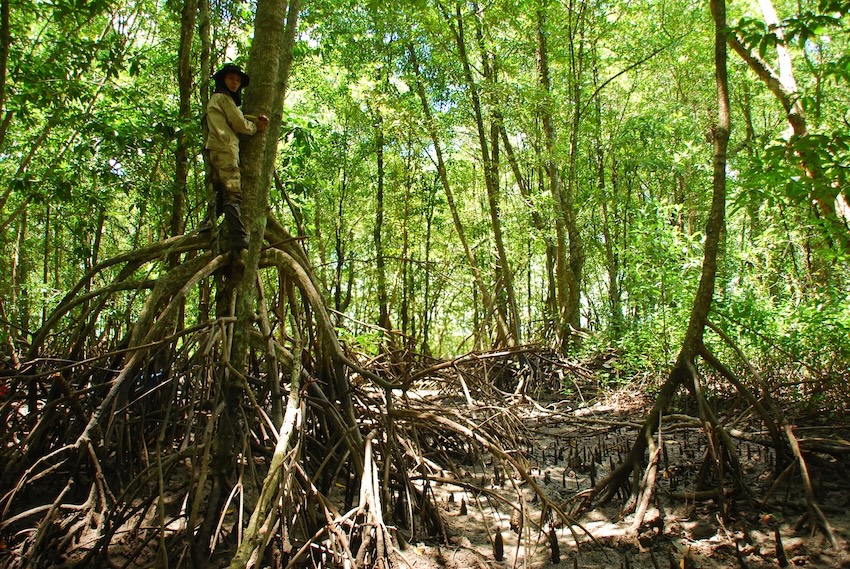
- Permanent plots in mangroves, seagrasses, and coastal forests
- Biomass, soil, and areal extent measurements
- Soil carbon burial rates from rSETS, cores, and radionuclides
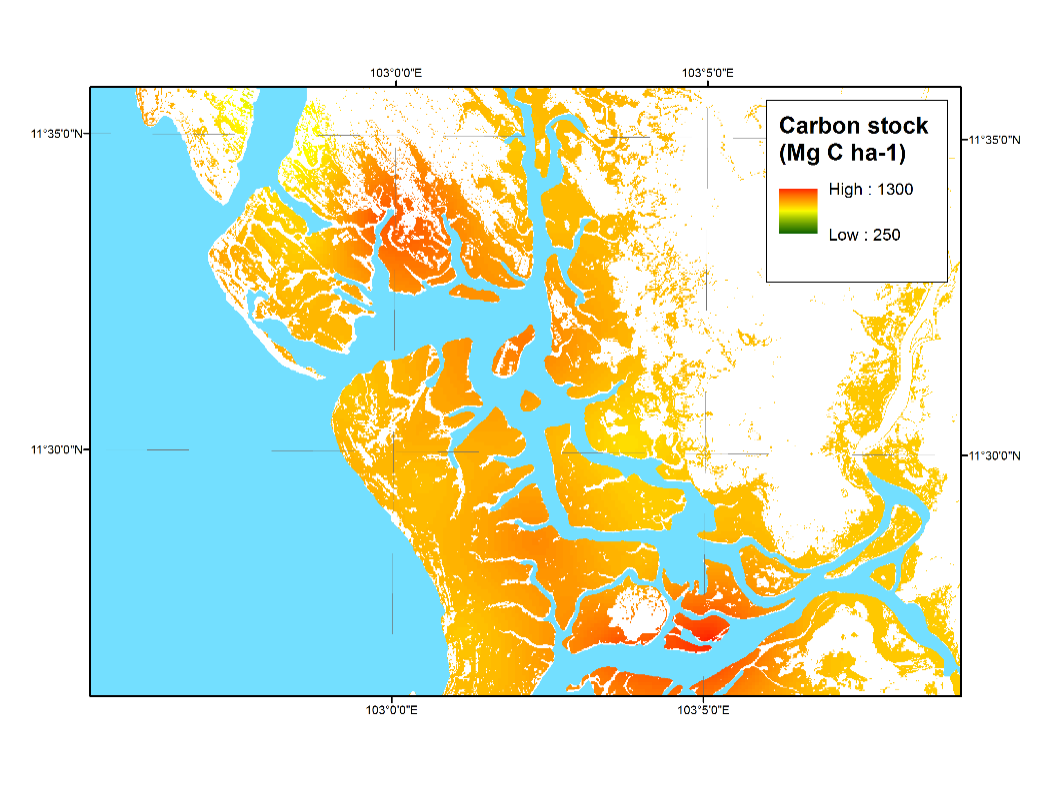
- Remote sensing for landscape change
Reporting
Translating monitoring data into national and international climate reporting.
- Blue carbon stock and flux estimates (Tier 2/3)
- Emission factors for Palau’s GHG inventory
- Inputs for NDCs, GHG Inventories, and climate communications
- Coastal resilience indicators for planning and finance
Verification
Ensuring accuracy, transparency, and reproducibility.
- QA/QC aligned with SWAMP and IPCC guidelines
- Repeat sampling for carbon gain/loss assessments
- Independent checks and uncertainty analysis
- Transparent documentation of methods
How the MRV System Works
Our workflow connects field data to national reporting using a simple SWAMP → IPCC pathway.
-
1
Design. Select sites, indicators, and sampling schedules.
-
2
Measure. Field surveys, biomass/soil cores, and LiDAR.
-
3
Analyze. Apply SWAMP models to estimate stocks, fluxes, and trends.
-
4
Report. Generate site summaries and national reporting inputs.
-
5
Verify. Conduct QA/QC, repeat measurements, and uncertainty analysis.
Where We Are Working
We monitor mangroves, seagrasses, and coastal forests using the same
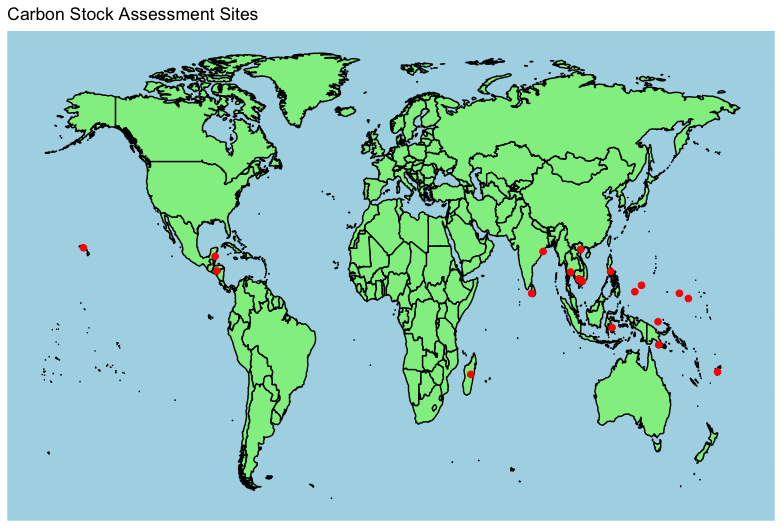
standardized protocols applied by SWAMP and International Partnership for Blue Carbon. We have worked in 16 countries to date.
- • Mangroves: Cambodia, Federated States of Micronesia (Kosrae, Pohnpei, Yap), Fiji, Honduras, India, Indonesia, Madagascar, Malaysia, Mexico, Palau, Papua New Guinea, Philippines, Sri Lanka, Thailand, United States, and Viet Nam
- • Seagrasses: Palau
- • Instruments: rSETs, sediment screens, water-level loggers, drone LiDAR, soil carbon cores, LGR CO2/CH4 analyzer
Selected Publications & Outputs
Key publications and reports drawing on MRV data and SWAMP methods.
-
Cole, T.G., R.A. MacKenzie, D.D. Donato, S. Sharma, L. Isechal, O. Sadang, and N.G. Johnson. (In review).
Ecological Monitoring and Structure of the Coastal Mangroves of Babeldaob Island, Republic of Palau.
Ecological Applications.
-
Bourgeois, C., R.A. Mackenzie, S. Sharma, R.K. Bhomia, N.G. Johnson, A.S. Rovai, T.A. Worthington, K.W. Krauss,
A. Kangkuso, J.J. Bukoski, J.A. Castillo, A. Elwin, L. Glass, T.C. Jennerjahn, M. Mangora, C. Marchand, M.J. Osland,
I.A. Ratefinjanahary, R. Ray, S.G. Salmo III, S.D. Sasmito, R. Suwa, P.H. Tinh, and C.C. Trettin. (2024).
Less than a quarter century to recover up to 75% of mangrove lost carbon stocks through planting.
Science Advances 10(27): eadk5430.
-
Salmo III, S.G., S.P.B. Manalo, P.B. Jacob, M.E.B. Gerona-Daga, C.F.P. Naputo, M.W.A. Maramag, M. Basyuni,
F. Sidik, and R.A. MacKenzie. (2024).
Improving soil carbon estimates of Philippine mangroves using localized organic matter to organic carbon equations.
Carbon Balance and Management 19(1): 31.
-
Analuddin, K., S. Sharma, L.O. Kadidae, L.O.M.Y. Haya, A. Septiana, S. Rahim, L. Syahrir, L. Aba, L.O.A. Fajar,
R.A. MacKenzie, and K. Nadaoka. (2023).
Blue carbon stock in sediments of mangroves and seagrass ecosystems at Southeast Sulawesi, Indonesia.
Ecological Research 38(4): 508–520.
-
Azman, M.S., S. Sharma, M.L. Hamzah, R.M. Zakaria, K. Palaniveloo, and R.A. MacKenzie. (2023).
Total ecosystem blue carbon stocks and sequestration potential along a naturally regenerated mangrove forest chronosequence.
Forest Ecology and Management 527: 120611.
-
MacKenzie, R.A., K.W. Krauss, N. Cormier, E. Eperiam, J. van Aardt, A.R. Kargar, J. Grow, and J.V. Klump. (2023).
Relative Effectiveness of a Radionuclide (210Pb), Surface Elevation Table (SET), and LiDAR at Monitoring Mangrove Forest Surface Elevation Change.
Estuaries and Coasts, pp. 1–13.
-
Woltz, V.L., E.I. Peneva-Reed, Z. Zhu, E.L. Bullock, R.A. MacKenzie, M. Apwong, K.W. Krauss, and D.B. Gesch. (2022).
A comprehensive assessment of mangrove species and carbon stock on Pohnpei, Micronesia.
PLOS ONE 17(7): e0271589.
-
Azman, S.M., S. Sharma, M.A. Muizz Shaharuddin, M.L. Hamzah, S.N. Adibah, R.M. Zakaria, and R.A. MacKenzie. (2021).
Stand structure, biomass and dynamics of naturally regenerated and restored mangroves in Malaysia.
Forest Ecology and Management 482: 118852.
-
Murdiyarso, D., S.D. Sasmito, M. Sillanpää, R.A. MacKenzie, and D. Gaveau. (2021).
Mangrove selective logging sustains biomass carbon recovery, soil carbon, and sediment.
Scientific Reports 11: 1–10.
-
Rovai, A.S., R.R. Twilley, E. Castañeda-Moya, S.R. Midway, D.A. Friess, C.C. Trettin, J.J. Bukoski, A.E.L. Stovall,
P.R. Pagliosa, A.L. Fonseca, R.A. Mackenzie, A. Aslan, S.D. Sasmito, M. Sillanpää, T.G. Cole, J. Purbopuspito, M.W. Warren,
D. Murdiyarso, W. Mofu, S. Sharma, H.T. Pham, and P. Riul. (2021).
Testing macroecological patterns and drivers of mangrove forest structure and carbon stocks across biogeographic regions and coastal morphologies.
Global Ecology and Biogeography 30(5): 1000–1013.
-
Kargar, A.R., R.A. MacKenzie, M. Apwong, E. Hughes, and J. van Aardt. (2020).
Stem and root assessment in mangrove forests using a low-cost, rapid-scan terrestrial laser scanner.
Wetlands Ecology and Management 28: 883–900.
-
Kauffman, J.B., M.F. Adame, V.B. Arifanti, L.M. Schile Beers, A.F. Bernardino, R.K. Bhomia, D.C. Donato,
I.C. Feller, T.O. Ferreira, M.d.C.J. Garcia, R.A. MacKenzie, J.P. Megonigal, D. Murdiyarso, L. Simpson, and H.H. Treijo. (2020).
Total ecosystem carbon stocks of mangroves across broad global environmental and physical gradients.
Ecological Monographs.
-
MacKenzie, R.A., S. Sharma, and A. Rovai. (2020).
Environmental drivers of blue carbon dynamics in mangrove forests.
In F. Sidik & D. Friess (Eds.), Dynamic Sedimentary Environments of Mangrove Coasts. Elsevier Publishing.
-
Sharma, S., R.A. MacKenzie, T. Tieng, K. Soben, N. Tulyasuwan, A. Resanond, G. Blate, and C.M. Litton. (2020).
The impacts of degradation, deforestation and restoration on mangrove ecosystem carbon stocks across Cambodia.
Science of the Total Environment 706: 135416.
-
Pham, H.T., V.V. Thanh, N.T.H. Hanh, M.S. Tuan, P.V. Quang, S. Sharma, and R.A. MacKenzie. (2020).
A comparison of soil carbon stocks of different mangrove forests in Northern Vietnam.
Forests.
-
Soper, F.M., R.A. MacKenzie, S. Sharma, T.G. Cole, C.M. Litton, and J.P. Sparks. (2019).
Non-native mangroves support carbon storage, sediment carbon burial, and accretion of coastal ecosystems.
Global Change Biology 25: 4315–4326.
-
Bhomia, R.K., R.A. MacKenzie, D. Murdiyarso, S.D. Sasmito, and J. Purbopuspito. (2016).
Impacts of land use on Indian mangrove forest carbon stocks: implications for conservation and management.
Ecological Applications 26: 1396–1408.
-
Nam, V.N., S.D. Sasmito, D. Murdiyarso, J. Purbopuspito, and R.A. MacKenzie. (2016).
Carbon stocks in artificially and naturally regenerated mangrove ecosystems in the Mekong Delta.
Wetlands Ecology and Management 24: 231–244.
-
Donato, D.C., J.B. Kauffman, R.A. MacKenzie, A. Ainsworth, and A.Z. Pfleeger. (2012).
Whole-island carbon stocks in the tropical Pacific: implications for mangrove conservation and upland restoration.
Journal of Environmental Management 97: 89–96.